UK hybrid working statistics: what the data says, 2024 to 2026
Hybrid working in the UK has barely moved since 2024. Office occupancy has. Here are the numbers that matter for anyone planning an office, and what they mean for the year ahead.
 The DuoMe team ·

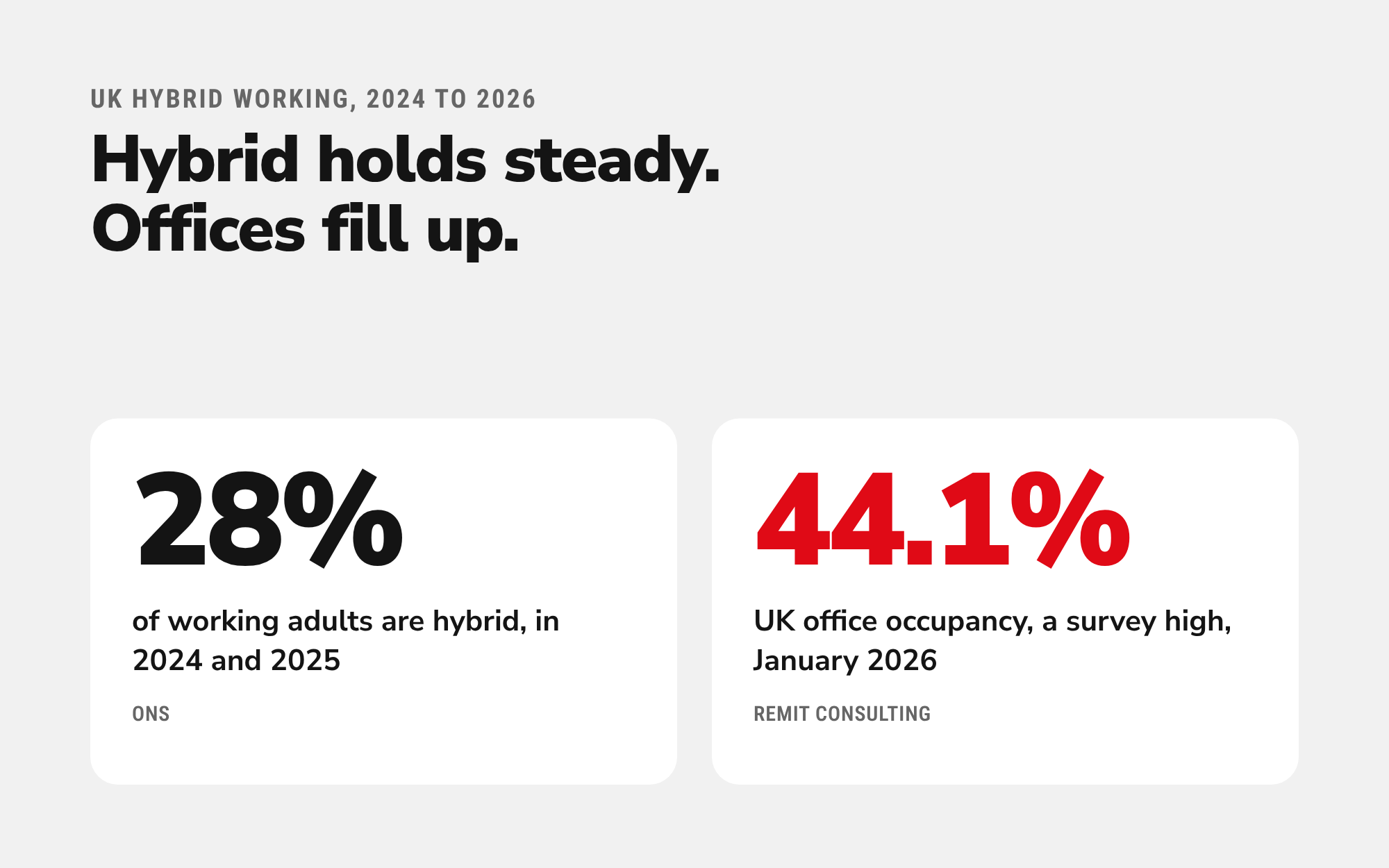
Two numbers sum up hybrid working in the UK since 2024. The share of workers who are hybrid has stayed at about 28%. Meanwhile, the share of office space in use on a typical week has climbed to a record 44%.
So the story is not a “return to the office”. It is the same people coming in more, on the same days. The busiest days are getting fuller, and that is what decides how much office you need.
This page collects the UK figures we think matter most, each linked to its source. Data is as of 6 November 2026, and we’ll update it as new releases land.
The headline numbers
| Measure | Figure | Period | Source |
|---|---|---|---|
| Working adults in Great Britain who are hybrid | 28% | Autumn 2024 | ONS |
| Working adults in Great Britain who are hybrid | 28% | January to March 2025 | ONS |
| UK average office occupancy, week to 31 January | 37.1% | 2025 | Remit Consulting |
| UK average office occupancy, week to 30 January (survey high) | 44.1% | 2026 | Remit Consulting |
| UK office occupancy, all weekdays | 30% | 2025 report | British Council for Offices |
| UK office occupancy, Tuesday to Thursday | 40% | 2025 report | British Council for Offices |
| Employers requiring a minimum number of office days | 51% | 2025 | CIPD |
Occupancy figures from different surveys measure different things, so compare each one with itself over time, not with the others.
Hybrid working has plateaued
The ONS found 28% of working adults in Great Britain were hybrid in autumn 2024. Its next release, covering January to March 2025, found the same 28%.
Who gets to work hybrid is uneven. In early 2025, 45% of workers earning £50,000 or more were hybrid, against 8% of those earning under £20,000.
Offices are getting fuller
While the hybrid share held steady, the office got busier. Remit Consulting’s survey of UK offices recorded average occupancy of 37.1% in the last week of January 2025. A year later, in the week to 30 January 2026, it reached 44.1%, the highest the survey has recorded. Remit says occupancy has now settled above 40%.
Remit also points to a widening gap between sectors. Investment banks are leading a firmer push back to the office, while other sectors stay closer to hybrid.
The week is uneven
Averages hide the peak. The British Council for Offices found UK offices are 30% occupied across all weekdays, but 40% from Tuesday to Thursday. Mondays and Fridays pull the average down.
US badge data shows the same shape. In the week to 27 October 2026, Kastle reported a national average of 56.5%, with Tuesday peaking at 66.7%. In the best-quality buildings, Tuesday hit 94.8%.
An office sized for the average day runs out of desks on Tuesday. One sized for every person sits half empty on Friday.
Mandates are up, attendance less so
Employers have pushed for more office time. In the CIPD’s 2025 research, 51% of organisations required staff in for a minimum number of days a week. 53% of employees said they felt pressure to spend more time in the office.
The cost of getting it wrong is real. The CIPD estimates around 1.1 million UK workers left a job in the previous year because of a lack of flexibility.
In the public sector, the civil service confirmed in October 2024 that 60% minimum office attendance would continue for most staff.
Mandates don’t translate one for one into attendance. In the US, the Flex Index found required office time rose 12% from early 2024 to Q3 2025, but actual attendance rose only 1 to 3%.
The law is moving towards flexibility
Since 6 April 2024, employees in Great Britain can ask for flexible working from their first day in a job (IoD). They can make two requests in 12 months, employers must answer within two months, and they must consult before refusing.
The Employment Rights Act goes further. Employers will need to show that refusing a request is reasonable, and explain why. This is currently scheduled for October 2027, though the date is not yet fixed in law. Acas published a draft Code of Practice on 1 October 2026, and the consultation closes on 17 December 2026 (Harper James).
For office planning, that means hybrid working is here to stay. Plans built on everyone being in five days a week will meet more requests they can’t reasonably refuse.
Office costs are rising
Space costs more to hold. In the 2026 business rates revaluation, office rateable values across England and Wales rose by an average of 14% (Knight Frank). In Central London, office take-up reached 9.43 million sq ft in 2025 (Savills).
Every desk you don’t need is worth more than it was. Every desk you’re short on Tuesday costs you in a different way. Our guide to downsizing your office for hybrid working shows how to cut space without running short, with a cost calculator.
What it means for your office
Put together, the data points one way. The share of hybrid workers is stable, but they come in more and on the same days. So size the office to your busiest day, not your headcount or your average.
Try it with your own numbers. The calculator turns your headcount and office days into the desks and space you need for a busy week.
Desks for a busy week
110desksTypical busiest day: 99
161 people at move-in, about 62% in on the busiest day. 110 desks cover it in about 19 weeks out of 20. A typical week needs 99.
From headcount to desks
Space by use
Net internal area (NIA), the area UK rents are quoted on.
Meeting rooms
10 rooms
Desks at 1 to 5 office days
Same method for every bar. Your setting is in red.
Then lower the peak. Spreading team days across the week can take a busiest day of 110 people down to 92, which you can test in the busiest-day planner. If you are moving, our guide on how to plan an office move puts it all in order, and how much office space you need per person explains the sums.
The best number of all is your own. DuoMe shows your busiest and quietest days from real desk bookings, so your next plan starts from your office, not the national average.
Frequently asked questions
What percentage of UK workers are hybrid?
28% of working adults in Great Britain were hybrid working in both autumn 2024 and January to March 2025, according to the ONS.
How full are UK offices?
Remit Consulting recorded average UK office occupancy of 44.1% in the week to 30 January 2026, the highest in its survey, and says occupancy has settled above 40%. The British Council for Offices found 30% across all weekdays and 40% from Tuesday to Thursday.
What is the busiest day in the office?
Tuesday, in most offices. UK offices are fullest from Tuesday to Thursday, and US badge data puts Tuesday as the national peak.
Can an employer refuse a flexible working request?
Yes, for set business reasons, and they must consult the employee first and decide within two months. Under the Employment Rights Act, currently scheduled for October 2027, employers will also need to show the refusal is reasonable. This is not legal advice.


