Downsizing your office for hybrid working
Most hybrid offices pay for desks that sit empty. But cut to the average day and Tuesday doesn't fit. Here is how to downsize safely, with a cost calculator for your own numbers.
 The DuoMe team ·

Most hybrid offices pay for more desks than they use. On an average day, a typical UK office is less than a third full. So downsizing looks like an obvious saving.
The risk is cutting too far. An office sized for the average day runs out of desks on Tuesday, and people stop coming in. Many firms that cut space after the pandemic now say they went too far.
The safe way to downsize is to size for your busiest day, not your average day. This guide sets out the steps: what each desk costs, how many you need, how to lower the peak before you cut, and when to act on your lease.
Why so many firms are cutting space
Two pressures push the same way.
Offices are underused. The British Council for Offices found UK offices are 30% occupied across the working week, and 40% from Tuesday to Thursday. Most desks sit empty most of the time.
Space costs more to hold. In the 2026 business rates revaluation, office rateable values across England and Wales rose by an average of 14% (Knight Frank). Rent is often only half to two-thirds of what a desk really costs, once you add rates, service charge and fit-out.
So plenty of firms plan to cut. In CBRE’s 2025 European occupier survey, 55% of companies expected to reduce their office footprint in the medium term, mostly because of hybrid working. In the UK, 18.8% of decision-makers in the Irwin Mitchell Office Occupiers Survey 2026 said they plan to downsize.
The mistake: cutting to the average
Firms that cut fast have often regretted it. In Irwin Mitchell’s 2025 survey of over 500 UK decision-makers, 63% said they had downsized too aggressively for hybrid working, and 45% were looking to expand again within a year (Startups.co.uk). CBRE found 21% of companies that had cut too far were now expanding, up from 7% a year earlier.
The usual cause is sizing to the average. Attendance is uneven across the week, and people pick the same days. CBRE’s survey puts average desk use at 46% across the week but 71% on the peak day. An office sized for 46% runs out of desks on the day most people come in.
When there’s nowhere to sit, people stop coming in. Then attendance falls, and the office looks even emptier on paper than it is.
Step 1: Work out what each desk costs
Start with the money, because it tells you what a cut is worth. Add rent, business rates, service charge, fit-out spread over the lease, and a provision for dilapidations, then divide by your desks.
The calculator below does it with your own numbers. The figures filled in are our example: a 14,000 sq ft Grade A office in Manchester with 120 desks, 140 people, and 42% of them in on an average day.
All-in cost per desk per year
£9,598
What a square foot costs you a year
Right-size at your next lease event
Savings count rent, rates and service charge only. Fit-out already spent isn't recovered. Options below your busiest day are greyed out.
Your lease timeline
Not legal advice. Check your lease for the break date, notice period and conditions, and talk to your solicitor before serving notice.
In the example, each desk costs about £9,600 a year all in, or £82 per sq ft. That is £1.15m a year for the office.
On an average day, about 59 people come in, so 61 desks sit idle. That looks like £587,000 a year of empty space. But you can’t give all of it back, because most of those desks are needed on the busiest day.
Step 2: Size to your busiest day
The figure that matters is how many people are in on your busiest day. In the example, that is about 69 people, or 49%. So 51 desks sit empty even at the peak, and those are the ones you can give up. Dropping them is worth about £397,000 a year in rent, rates and service charge.
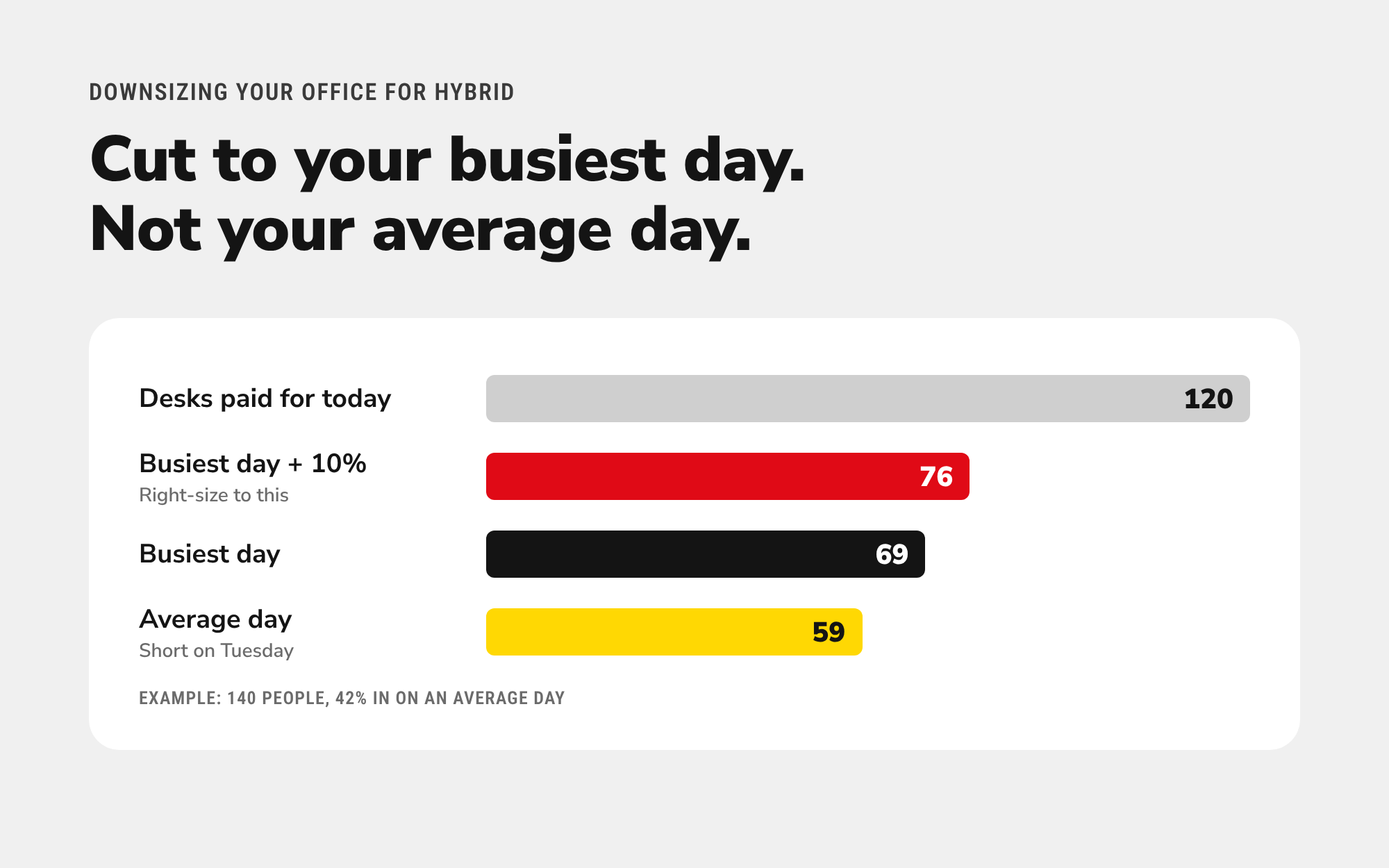
Leave some room. A busiest day in a normal week is not the busiest day of the year. Adding a 10% buffer takes the example to 76 desks, 44 fewer than today, and still saves about £343,000 a year.
The model uses your average day times 1.17 to estimate the peak, based on badge data from Kastle. Your own office may be more or less peaky. Before you commit to a smaller space, measure your real busiest day over a few months and put it in the calculator under “In on your busiest day”.
For the full method, from people to desks to square feet, see our guide on how much office space you need per person.
Step 3: Lower the peak before you cut
The busiest day isn’t fixed. If everyone picks Tuesday, the peak is high. If teams have set days spread across the week, it comes down, and so does the number of desks you need.
Set team days before you size the new space, not after. A lower peak can mean a smaller floor, fewer meeting rooms and a bigger saving at the same level of attendance. You can test it with your own teams in the busiest-day planner.
Two things to plan for:
- Assigned desks. Anyone who needs their own desk every day takes it out of the shared pool. Count them separately.
- Anchor days. If you want everyone in on the same day for an all-hands, that day sets your peak. Hold it in a different space, or make it less often.
Step 4: Choose how to give space back
You can only save money when a lease lets you hand space back. The main routes are:
- Break the lease. Leave at a break date written into the lease. Break clauses often come with conditions, such as rent paid up to date and the space handed back empty.
- Leave at expiry. Move to a smaller office, or renew on a smaller part of the building.
- Give back part of the building. Some landlords will agree to take back a floor, often in return for a longer lease on the rest.
- Assign or sublet. Pass the lease, or part of the space, to another occupier, if the lease allows it.
Each route has different costs and risks. None of this is legal advice, so involve your surveyor and solicitor early.
Step 5: Time it to your lease
Downsizing takes longer than most people expect. Strutt & Parker says finding and moving into new premises can take up to 12 months, and many businesses get in touch with only three to six months left on their lease.
Work back from your break or expiry date:
- Break or expiry. The date the saving starts.
- Serve notice. Often six to twelve months before a break. Check your lease for the exact date and how notice must be served.
- Decide. Leave time for sign-off and legal review before the notice date. We allow eight weeks.
- Start measuring. Get at least three months of real attendance data before you decide.
Enter your break date and notice period in the calculator above and it draws this timeline for you.
Plan for dilapidations too: the cost of returning the space to the condition the lease requires. The landlord usually serves a schedule within 56 days of the lease ending, and the claim can’t exceed the fall in the property’s value caused by the breaches (RICS).
If you are moving to a smaller office rather than cutting in place, our guide on how to plan an office move covers every step.
Downsizing checklist
- Cost per desk worked out, all in, not only rent.
- Busiest day measured over at least three months.
- Team days set, and the peak lowered, before the new space is sized.
- Assigned desks counted separately.
- A buffer added for busy weeks.
- Break date, notice period and break conditions checked with your solicitor.
- Dilapidations budgeted.
- Desk booking ready before the smaller space opens, so people can see where they’ll sit.
Measure before you cut
Every figure in this guide is a model until you replace it with your own. The safest downsizing decision starts from your real busiest day. DuoMe shows your busiest and quietest days from desk bookings, so you can see the peak before you serve notice and check the new space works after the move.
Frequently asked questions
How much can you save by downsizing an office?
It depends on how many desks you can give up and what each one costs. In our example, a 120-desk Manchester office could drop 44 desks and save about £343,000 a year in rent, rates and service charge, with a 10% buffer above the busiest day. Fit-out you have already paid for isn’t recovered.
How many desks does a hybrid office need?
Enough for your busiest day, plus a buffer for busy weeks and any assigned desks. Sizing to the average day leaves you short when most people come in.
When should you start planning to downsize?
At least a year before your break or expiry date. You need time to measure attendance, decide, serve notice and, if you’re moving, find and fit out new space.
Can I leave my office lease early?
Only if the lease has a break clause or the landlord agrees. Break clauses usually have conditions, and missing one can mean the break fails. This is not legal advice, so check your lease with a solicitor.


