How to plan an office move: a step-by-step guide for hybrid teams
Most office moves are planned from headcount and a removals checklist. In a hybrid office, that buys the wrong amount of space. Here is how to plan the move in five steps, starting from how the week really runs.
 The DuoMe team ·

Moving office is one of the few times you can change how your workplace runs from scratch. It is also the time it is easiest to get wrong. Most move plans start with headcount and a removals checklist. In a hybrid office, headcount is the wrong number to start from, and the checklist comes far too late.
You’re not alone in planning one. In the Irwin Mitchell Office Occupiers Survey 2026, 31.6% of 500 UK decision-makers said they plan to relocate, up from 23.2% the year before. Another 18.8% plan to downsize.
This guide covers the decisions that shape the move, in the order you need to make them. It follows the five steps of our move planner, which is built into this page. Put in your own numbers and each step below explains the answer you get.
Why most office moves are planned back to front
The usual order is: find a building, sign the lease, plan the fit-out, then work out where everyone sits. The seating plan comes last, often as a spreadsheet the week before move-in.
In a hybrid office, that order means you choose the space before you know how much of it you need. And the answer is rarely “one desk per person”.
The British Council for Offices found UK offices are 30% occupied across the working week, rising to 40% from Tuesday to Thursday. So a desk for every person means paying for a lot of empty desks. Cut too far, though, and Tuesday doesn’t fit. Our round-up of UK hybrid working statistics has the latest figures.
The fix is to decide how the week will run before you decide how big the office should be. That’s why the steps below start with people and the week, and leave the building until step 3.
Plan your move with your own numbers
Each answer feeds the next. Change a number and the whole plan updates. The figures already filled in are the worked example used throughout this guide: 140 people today, growing 15% by move-in.
Set up the new floor
Draw the floor in DuoMe, to scale. Place each team, give key people their own desk, and set team days. Rather we drew it? Send us your plan.
Your move plan
- People at move-in
- 161
- Busiest day
- 110 people (92 with team days spread)
- Desks
- 110
- Meeting rooms
- 10
- Space and floors
- About 13,800 sq ft, 2 floors
- Serve notice by
- 30 Apr 2027
The plan goes with you in the link: numbers only, nothing personal.
Step 1: Who’s moving?
Start with three numbers.
- People today. Everyone who will use the new office, including part-time staff and regular contractors.
- Growth by move-in. Your hiring plan up to the move date, and a view of the first two or three years of the lease. Leases are long, so a 10-year lease signed for today’s team will be wrong by year three.
- People who need their own desk. Some roles need an assigned desk every day: reception, specialist kit, or reasonable adjustments. Assigned desks are never shared, so count each one as a whole desk.
Worked example: 140 people today with 15% growth gives 161 people at move-in. Nobody has an assigned desk, so all 161 share.
Step 2: How will the week run?
This is the step most move plans skip, and it’s the one that sets the size of the office.
You need two answers: how many days a week people come in, and which days. If people choose freely, they cluster midweek. Badge data from Kastle puts the peak Tuesday at about 1.17 times the weekly average. Your office has to fit that Tuesday, not the average.
Worked example: 161 people coming in three days a week, choosing their own days. On a typical week the busiest day has about 99 people in. In a busy week it reaches about 110.
Then try team days. Set which days each team comes in, and spread the teams so the same day doesn’t carry everyone. Sales might take Monday, Thursday and Friday while Product takes Monday to Wednesday.
The busiest day drops from 110 to 92. That is 18 fewer desks, before you have looked at a single building. It also means each team knows when the people it works with will be in, which is the main reason most people make the trip.
Try it with your own teams in step 2 of the planner above. Press “Spread team days for me” to see how low your busiest day can go.
Step 3: How many desks, rooms and floors?
Now turn people into space. Size desks to your busiest day in a busy week, plus any assigned desks.
- Desks. In our example, 110 desks if people choose their own days, or 92 with team days spread.
- Meeting rooms. A common starting point is one room for every 10 to 12 desks, with a mix of sizes. Ask how meetings will work in a hybrid week. More of them will have someone on a screen, so small rooms and phone booths matter more than a big boardroom.
- Space per desk. UK benchmarks sit around 10 m² per person for general workspace (BCO) and about 100 sq ft per workstation all in (Lambert Smith Hampton). That covers circulation, kitchens and breakout space as well as the desk itself.
- Floors. Split the total across floors and check each team can sit together. A team split across two floors on its anchor day defeats the point of the day.
Worked example: 110 desks and 10 meeting rooms come to about 13,800 sq ft, or two floors of 6,900 sq ft.
Check the legal floor too. The HSE sets a minimum of 11 cubic metres per person in a workroom, though a properly furnished office needs far more than that.
Step 3 of the planner above does this for you. For more control over the assumptions, use the full office space calculator, and see how much office space you need per person for the method in detail. If the answer is less space than you have now, our guide to downsizing your office for hybrid working covers cutting it safely.
Step 4: When do you need to decide?
Work back from your lease, not forward from today.
- Break or expiry date. The date you can leave your current office.
- Notice date. Your break date minus the notice period in your lease. Notice periods are commonly six to twelve months.
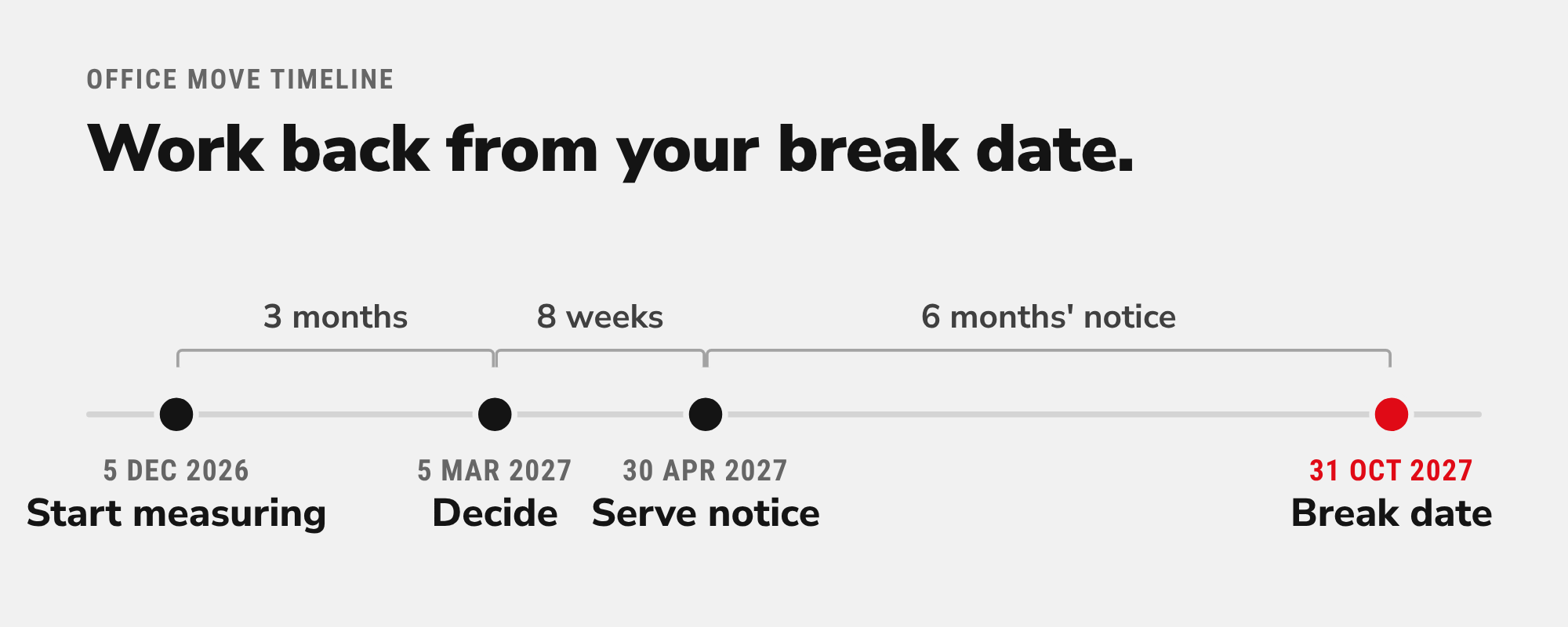
- Decision date. Set an internal deadline about eight weeks before the notice date. Leadership, finance and your solicitor all need time to agree.
- Start measuring. Begin measuring your real busiest day at least three months before the decision date. You want evidence for the space you are committing to, not a guess.
Worked example: a break date of 31 October 2027 with six months’ notice means serving notice by 30 April 2027. Start measuring your busiest day by early December 2026.
Step 4 of the planner above works out these dates from your own break date and notice period.
Moves take longer than most people expect. Strutt & Parker puts a typical move at up to 12 months: searching, negotiating, legals, fit-out and the move itself. A workplace review adds two to three months. Many firms start with only three to six months left on their lease, which leaves no room for anything to slip.
If you are leaving at a break, read the break conditions carefully. They often require rent to be paid up to date and the space handed back empty. Plan for dilapidations too: the cost of returning the space to the condition the lease requires. RICS has a plain-English guide. None of this is legal advice, so involve your surveyor and solicitor early.
Step 5: Set up the new floor before anyone moves in
Once you have the space, plan where people sit before move day, not after.
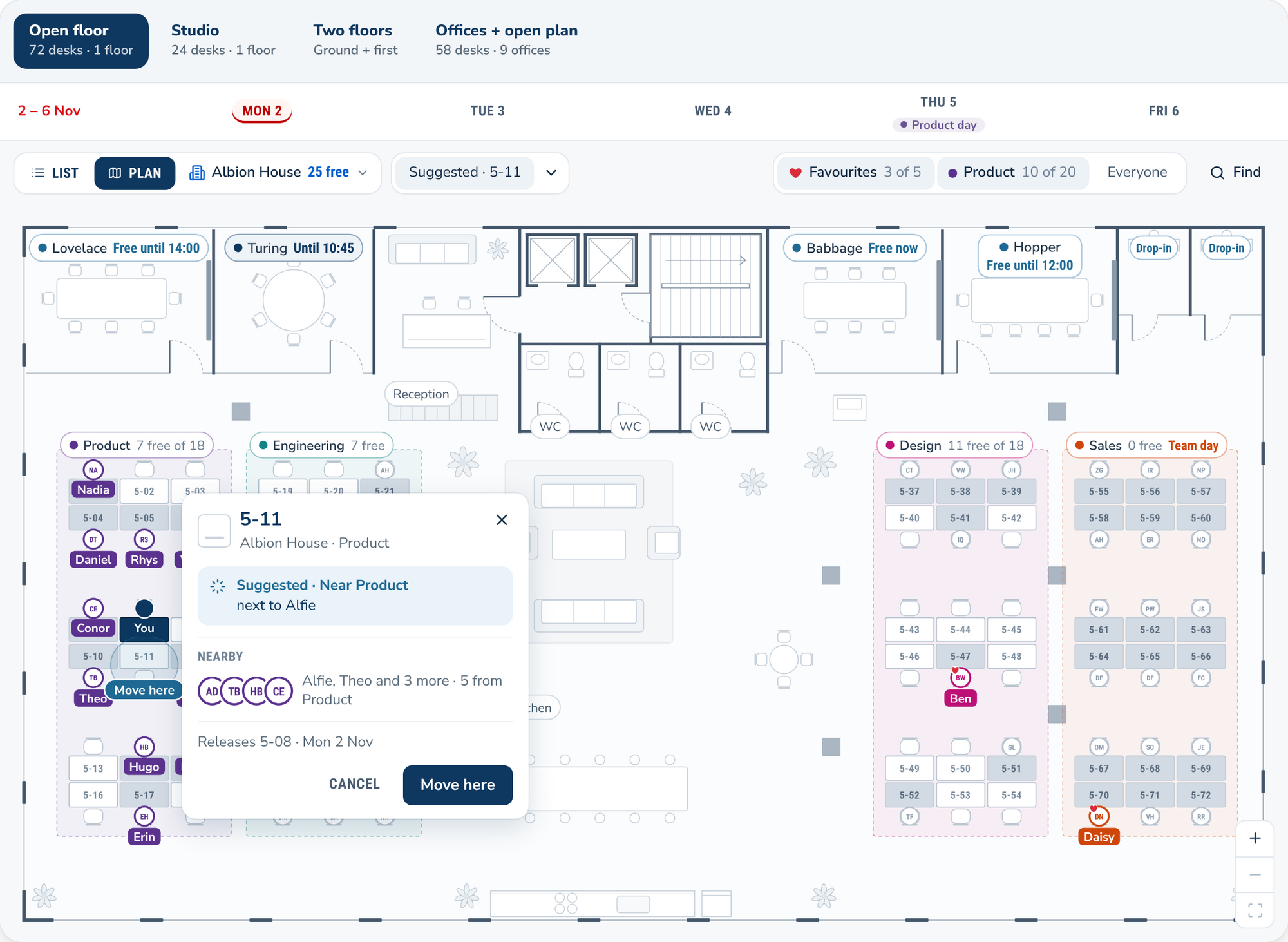
- Draw the floor to scale from the landlord’s or fit-out plan, with every desk and room.
- Place teams in neighbourhoods. Put each team in its own area, and teams that work together near each other.
- Give assigned desks to the people who need them.
- Set team days so each team’s area is ready on its anchor day.
- Test it. Check each day of the week fits, and change the layout on paper before it’s fixed in furniture.
In DuoMe, you draw the floor, place teams, assign desks and set team days in one place, and booking is open before the doors are. Rather we drew it for you? Send us your plan.
The practical checklist
The steps above shape the move. You still need the practical list. Most of it can run in parallel once the lease is signed.
Three to six months before
- Appoint a fit-out or design-and-build partner, and agree the programme
- Order the network, broadband and phones. Lead times for new lines can be long
- Book removals and IT decommissioning for the old office
- Review contracts at the old site: cleaning, security, catering, printers and waste
- Plan access control, fire safety and first aid at the new site
One to three months before
- Tell clients, suppliers and your bank about the new address
- Update your website, Google Business Profile and email signatures, and set up post redirection
- Confirm the seating plan and team days, and share them with every team
- Plan parking, cycle storage and travel for anyone whose commute changes
The last month
- Label furniture and kit for the new floor
- Test the network, room screens and door access before day one
- Send everyone their first-week details: their floor, their team’s days and where they’ll sit
Telling your people
People want to know four things, in roughly this order: why you’re moving, where, when, and how their week changes. Tell them early, and before the news reaches them some other way.
If the move changes anyone’s place of work, check their contract and talk to them before you confirm it. Acas explains how to propose a change.
Then answer the question everyone asks: “Where do I sit, and which days are my team in?” If they know that before day one, the move feels planned rather than done to them.
Moving day and the first fortnight
On day one, people should arrive knowing their floor, their team’s day and their desk. Have people on each floor to help, and expect the network and room screens to need fixing in the first week.
Then measure. Look at how full each day is over the first two to four weeks. If one day runs over, move a team’s anchor day. If an area sits empty, change it. A new office is easier to adjust in the first month than at any time after.
Frequently asked questions
How far in advance should you plan an office move?
Start 12 to 18 months before your lease break or expiry. That leaves three months to measure how the current office is used, time to decide before your notice date, and a typical search, legal and fit-out programme of up to 12 months.
How much office space do you need per person?
UK benchmarks are around 10 m² (about 100 sq ft) per person for general workspace, all in. In a hybrid office, multiply by the number of people on your busiest day, not your total headcount. The office space calculator works it out for you.
How many desks does a hybrid office need?
Enough for your busiest day in a busy week, plus any assigned desks. For 161 people coming in three days a week, that is about 110 desks if people choose their own days, or about 92 with team days spread across the week.
Should you downsize when you move?
Only after you have measured your busiest day. Many hybrid offices can shrink, but cutting to the average day leaves no room on Tuesday. Spreading team days first lowers the peak, which is what makes a smaller office work.


